Skip to content

Technology

GBT-M high-efficiency bioreactor

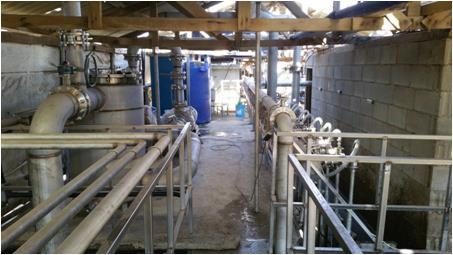
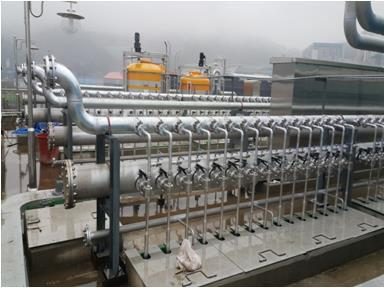
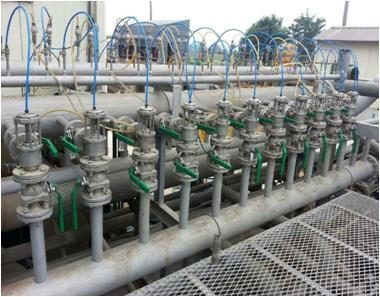
The GBT-M reactor combines the strengths of continuous stirred-tank (CFSTR) and plug-flow (PFR) reactors in a vertical multi-stage design, shortening treatment time for high-strength organic wastewater and raising organic removal efficiency.

How GBT-M works

  1. 1

    Wastewater and air entering the nozzle accelerate rapidly, and the strong rotational force creates a vacuum at the tip of the air inlet.

  2. 2

    The vacuum draws in large volumes of air, which collide with the wastewater in two mixing chambers and form microbubbles a few hundred micrometres across.

  3. 3

    The microbubbles contact the mixed liquor over a large area, maximising oxygen dissolution while also diluting and mixing.

Advantages of GBT-M

Built for high strength

Suited to very concentrated effluent such as food waste leachate.

Minimal footprint

High-load operation needs only 1/5–1/20 of a conventional tank’s area.

Retrofits existing plants

Fits even shallow existing tanks and relieves reactor capacity shortages.

Few moving parts

No machinery inside the reactor means fewer breakdowns and easy repair.

Long-life nozzles

Stainless steel or PE nozzles last for years and supply oxygen steadily.

Resists shock loads

High MLSS and recirculation dilution limit the impact of toxic or shock loads.

Less odor on site

Our unrivaled, specialized microbial technology and operating know-how reduce odor.

Compared with conventional technology

CriteriaGBT-M reactorConventional aeration tank
Reactor designEnclosed PFR, vertical multi-stage (3–20 m deep)CFSTR (4–5 m deep)
Bubble sizeMicrobubbles of a few hundred µmDisc diffusers, up to 1 mm
Oxygen transfer rate3–10 kgO₂/kW·h1.2–2.0 kgO₂/kW·h
BOD volumetric loading3–60 kgBOD/m³·d (standard 5)0.3–0.8 kgBOD/m³·d (standard 0.5)
Footprint1/5–1/20 of a conventional tankLarge area required
MLSSAbove 5,000 mg/L1,500–5,000 mg/L
TKN volumetric loading0.4–1.2 kg/m³·dUp to 0.06–0.2 kg/m³·d
Shock loadsLittle impact thanks to high MLSS and recirculationRisk of microbial shock and shutdown
Ease of operationRelatively simple to runNeeds experienced specialists
Removal efficiencyBOD above 95%, nitrification above 99%Struggles with high organics and nitrogen

GBT additive · water-stable aggregate technology

Activated silicates and humic substances create a soil-like environment in which fungal hyphae and microbial binders knit fine particles into stable, water-resistant aggregates.

These aggregates have a high cation-exchange capacity: they capture nitrogen and stop ammonia odor at the source, while chelating metabolites remove other odorous compounds.

As beneficial soil microbes dominate, putrefying bacteria decline, preventing odor from decay in the first place.

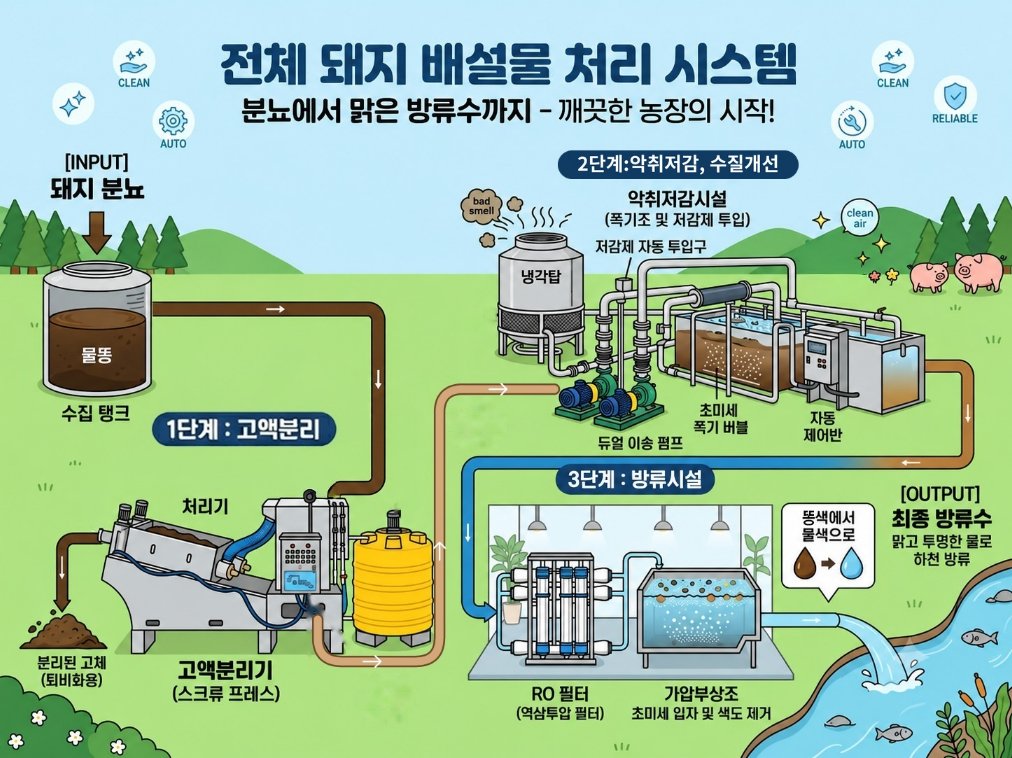
From manure to clear effluent

Solid–liquid separation → odor control and water treatment → discharge: the HAYEON GLOBAL livestock manure process

From manure to clear effluent — Solid–liquid separation → odor control and water treatment → discharge: the HAYEON GLOBAL livestock manure process
  1. 1

    Step 1 Solid–liquid separation

    a screw press removes solids for compost

  2. 2

    Step 2 Odor control & water treatment

    ultra-fine aeration with automatic dosing

  3. 3

    Step 3 Discharge

    RO filtration and dissolved air flotation return clear water to the river

Field performance data

Livestock wastewater plant, Eumseong Wastewater

Livestock wastewater plant, Eumseong

In operation

Eumseong, North Chungcheong 150 m³/day

High-strength livestock wastewater is treated with GBT-M after separation to within discharge limits. Composite odor fell from 1,442 to 20.

Influent
BOD 8,000 ppm · T-N 1,500 ppm (after separation)
Effluent
BOD ≤ 50 ppm · T-N ≤ 60 ppm
Livestock wastewater plant for a farming cooperative Wastewater

Livestock wastewater plant for a farming cooperative

In operation

275 m³/day

Treats 275 t/day of high-strength livestock wastewater within discharge limits.

Influent
BOD 8,500 ppm · T-N 1,600 ppm (after separation)
Effluent
BOD ≤ 50 ppm · T-N ≤ 60 ppm
High-strength food waste leachate treatment Wastewater

High-strength food waste leachate treatment

In operation

Gyeonggi 150 m³/day

After solids separation, GBT-M treats concentrated leachate to discharge standards.

Influent
BOD 8,000 ppm · TN 3,000 ppm
Effluent
BOD ≤ 50 ppm · TN ≤ 150 ppm
Sewage sludge condensate plant for a public environmental agency Wastewater

Sewage sludge condensate plant for a public environmental agency

In operation

680 m³/day

A public facility treating nitrogen-rich condensate from sludge drying.

Influent
BOD 300 ppm · TN 1,307 ppm
Effluent
BOD ≤ 20 ppm · TN ≤ 20 ppm
Paper mill industrial wastewater plant Wastewater

Paper mill industrial wastewater plant

In operation

6,000 m³/day

GBT-M reactors applied to large-volume paper mill effluent.

Influent
BOD 1,500 ppm · COD 900 ppm
Effluent
BOD 5 ppm · COD 30–50 ppm

Core patents

Wastewater treatment apparatus with microbial reactor

Wastewater treatment apparatus with microbial reactor

KR Patent No. 10-2269554

Livestock manure treatment method using microorganisms

KR Patent No. 10-2262472

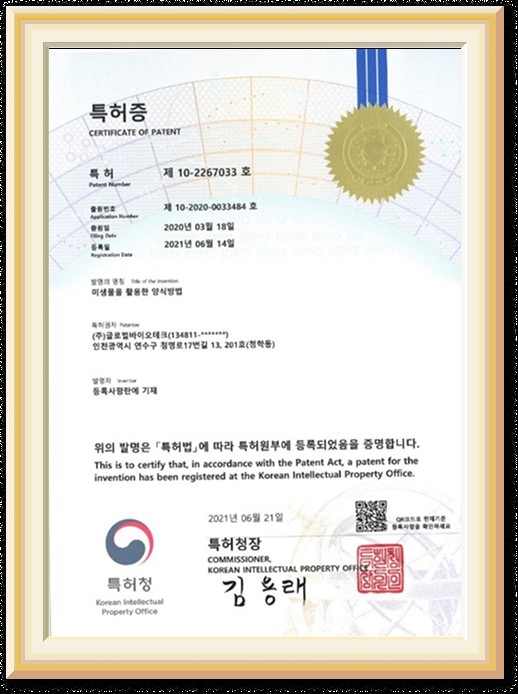
Aquaculture method using microorganisms

Aquaculture method using microorganisms

KR Patent No. 10-2267033

Resource recovery system for livestock manure and food waste

Patent application

Combines methane power, solids composting, liquid fertilizer and water reuse

Will it work at your site?

Just tell us the wastewater type and daily volume. We will assess your site and propose rental terms free of charge.

Call us Free consultation